

Pieter Huybers graduated in Architecture from Delft University of Technology (now Delft University of Technology) in 1962. After a brief period as an independent architect, he quickly returned to his university - this time not as a student, but as a researcher. This marked the beginning of an impressive career in which he became one of the pioneers in the field of structural morphology.
Within a year of graduating, Huybers was appointed head of the Plastics research group, under the leadership of Professor Tim Wildschut. The group was part of Civil Engineering and was located in the Stevin Laboratory.
The goal was ambitious and progressive: to develop load-bearing plastic structures without support beams. This raised fundamental questions:
In December 1972, Huybers received his doctorate for his dissertation "See-through Structuring - A Method of Construction for Large Span Plastic Roofs." In it, he developed his vision for transparent, lightweight plastic roof spans.
But shortly thereafter, the world changed dramatically. The 1973 oil crisis led to sharp price increases and shortages of petroleum products, including plastics. Interest in polyester construction rapidly declined. The department had to reorient itself and broadened its scope under the name Non-Residential Construction.
In 1976, Huybers received a special assignment from the Ministry of Development Cooperation:
to set up a housing project in Mali.
The goal was to develop modern, affordable homes that the country could continue to operate independently. This was completed in 1977.
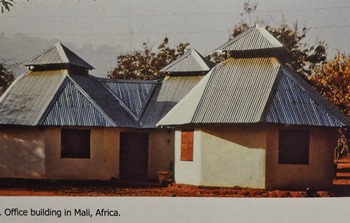
They had to work with locally available palm wood - a material that is rock-hard and splinters easily. What seemed like a limitation became a new design challenge. Here, Huybers' strength once again emerged: linking materials, geometry, and construction logic to create innovative solutions.
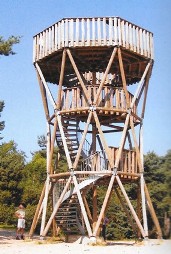
He also designed a number of buildings using round timber in the Netherlands, the most famous of which is the still well-maintained
lookout tower Uitkijktoren Berg & Bos
During the same period, he also worked on foldable emergency shelters for the Ministry of Emergency and Food Aid: lightweight, foldable building systems that could be deployed quickly. This was an example of how his theoretical knowledge directly found social significance.
As a (senior) lecturer and researcher at the Faculty of Civil Engineering of Delft University of Technology, Huybers became an authority on the morphology of building structures.
His great fascination lay in the mathematics and geometry behind polyhedra and their application in architecture and structural engineering. He investigated how regular and semi-regular polyhedra could be used to design efficient, elegant, and stable structures.
In doing so, he bridged the gap between abstract mathematics and practical engineering.
He was one of the four founders of IASS working group 15 'Structural Morphology', he remained active in this field well into his retirement and was awarded a prize for this in 2016.
Around 1980, well ahead of the digital age, Huybers and his colleagues developed a computer program that could calculate and visualize families of polyhedra and tessellations. At a time when graphic design software was practically nonexistent, this was revolutionary.
The program made it possible to systematically investigate complex geometric shapes and represented an important step towards the digital design methods that are commonplace today.
Publications such as The Morphology of Building Structures and Uniform Polyhedra for Building Structures are still cited in research on geometric structures, space frames, and geodesic domes. His work laid a foundation for modern form studies and parametric design. After retiring in 2000, he designed "the roundest football" and collected all his previous publications and presentations (including this football) in a single book, "Polyhedroids - That Family of Polyhedra."
Pieter Huybers was much more than a teacher or researcher. He was a visionary who made the hidden geometry behind structures visible. He combined experiment, mathematics, and social engagement into a cohesive design philosophy.
From plastic spans in Delft to housing in Mali, from polyhedrons on paper to early computer programs - Huybers demonstrated that innovation arises where technology, imagination and responsibility intersect.
A true pioneer between mathematics and architecture.